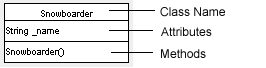
Class diagrams are a convenient way to graphically depict classes and their properties and methods.
A class box is broken down into 3 sections:
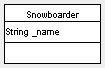
Here _name is an attribute of the Snowboarder
class. Its type is String, you may leave off the type information.
The code might look like the following:
public class Snowboarder {

   private String _name;

}
Remember attributes are simple properties which simply describe the object.
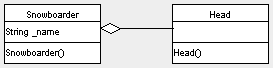
The diagram above shows that a Snowboarder has a
Head. That is, that the Head is a subpart of the Snowboarder.
Further, as Head is a part of the Snowboarder (the
whole), there are certain implications for lifetimes. That is that the Head
exists as long as the Snowboarder does. Additionally, the Snowboarder
is incomplete without a head. Therefore, a Snowboarder must have an instance
variable of type Head and it must call the Head constructor, see:
public class Snowboarder {

	private String _name;


   private Head _head;  // Step 1) of coding the "has a" relation.


   public Snowboarder() {

      _head = new Head();  // Step 2) of coding the "has a" relation.

   } // end Snowboarder constructor


} // end class Snowboarder
public class Head {
   public Head() {

      // do something interesting

   }

}
Notice the lack of any information about the Snowboarder class
in the Head class. That is because, the composition relationship is one-way
only! That is, the Head is blissfully unaware of the Snowboarder.

Our model is becoming more complete. Since Snowboarders
are accident-prone, they need to know a SkiPatroller, so
that they can be rescued. Since associations are a type of property there must
be an instance variable, however, the SkiPatroller is not a subpart of a Snowboarder.
The SkiPatroller exists prior to the Snowboarder. Instead, we must send in SkiPatroller
object into the constructor of a Snowboarder, like so:
public class Snowboarder {


   private String _name;

   private Head _head;

   private SkiPatroller _patroller;  // Step 1) of coding the "knows a" relation


   public Snowboarder(SkiPatroller sp) {

      _head = new Head();

      _patroller = sp;  			// Step 2) of coding the "knows a" relation

   } // end of Snowboarder constructor

} // end class Snowboarder


public class SkiPatroller {


   public SkiPatroller() {  }


}
Once again notice the lack of information about the Snowboarder
in SkiPatroller. This too is a one-way relation, starting to see
a pattern?

SkiPatrollers use sleds to rescue people. You can
show that one class is dependent on another via the uses relationship. The dashed
line above indicates that SkiPatroller uses a Sled.
This means that Sled is not an instance variable in SkiPatroller. Rather, something
in its code requires the sled class, it could be a local variable, a
formal parameter or merely have an unnamed instance created. Here
is an example that uses a local variable.
public class SkiPatroller {

   public void rescue(Snowboarder sb) {

      Sled sled = new Sled();   // SkiPatroller uses a Sled

	   sled.load(sb);

	   this.skiToPatrolRoom();  // method definition not shown

   }

}


public class Sled {

   public void load(Snowboarder bdr) {

      // implementation not shown

   }


}
Once again notice the relationship is one-way.
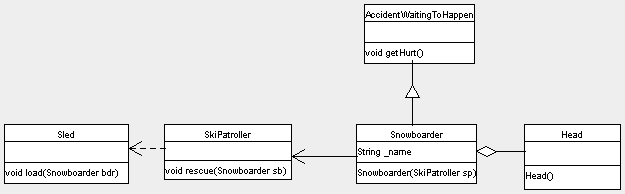
The overall theme is that a Snowboarder is just waiting
to get hurt, or colloquilly, an AccidentWaitingToHappen. This is
the inheritance relation. It is modelled using the keyword extends.
public class AccidentWaitingToHappen {

   public void getHurt() {

      // implementation not shown, otherwise we'd need a parental advisory :)

   }

}


public class Snowboarder extends AccidentWaitingToHappen {

   // the rest of the code is omitted, since it is irrelevant in this relation.


} // end class Snowboarder
Note, the AccidentWaitingToHappen has no information
about a Snowboarder.